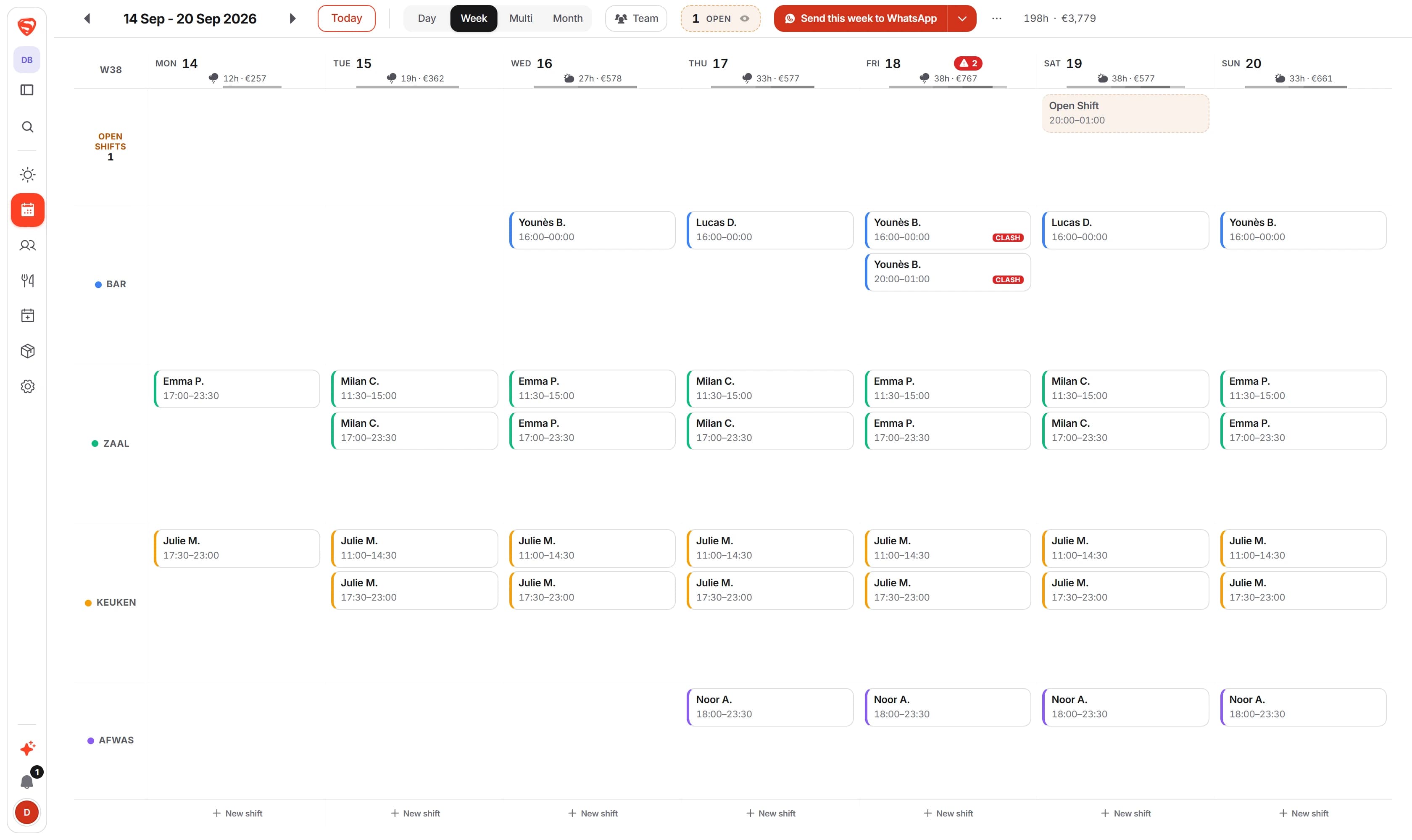
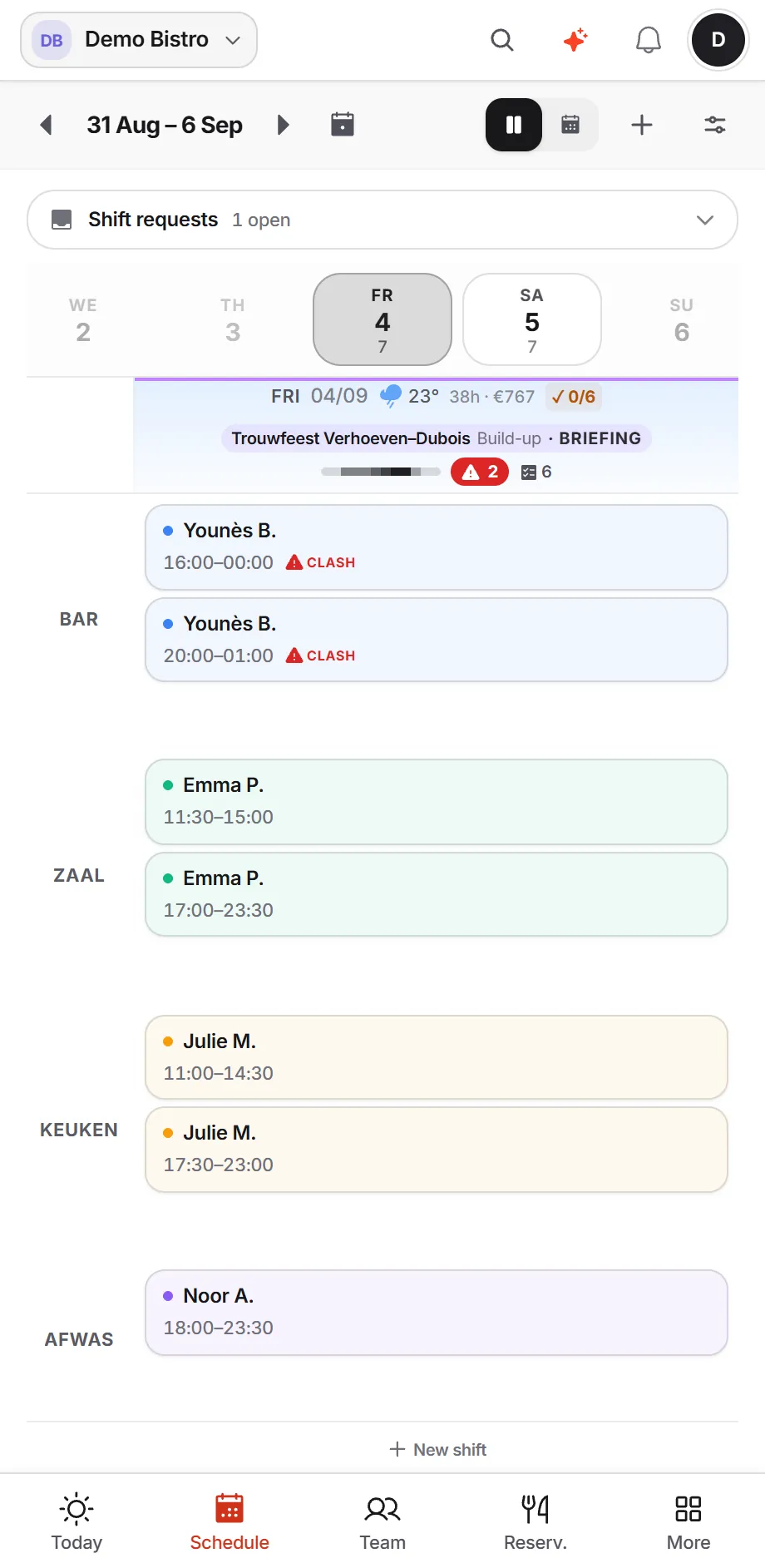
What is in that figure, and what is not
The sum is simple: each staff member’s paid hours, times what that person costs you per hour. You enter that hourly figure yourself, under your team. Each person has a gross hourly wage and a field called ‘Costs you’: what they really cost you per hour, all-in. If your payroll office has given you that number, enter it. It beats any estimate.
Leave ‘Costs you’ empty and SuperHoreca estimates it: the gross wage plus the employer percentage you set per contract type in the pay & cost calculator. That percentage stays at zero until you fill it in, so SuperHoreca never adds employer contributions you did not enter. To start from typical Belgian percentages, load them with one click and adjust them.
Two things are not in it. Someone without an hourly wage counts as zero. And bonuses or allowances your payroll office calculates per month or per year only count if you build them into that hourly figure. It is an estimate to plan with, not a payroll calculation.
Why it matters who you schedule
In Belgian hospitality an hour does not cost the same for everyone. Three statuses that almost every venue mixes, with the figures from the ONSS/RSZ and FPS Employment:
Flexi-job
Since 1 September 2026, a flexi-job worker in hospitality earns at least €12.11 an hour, plus €0.93 of flexi holiday pay: €13.04 in total. On top of that you pay a special employer contribution of 28%, holiday pay included. A flexi hour therefore costs you at least €16.69 in wage and contribution.
Student
A student can work 650 hours per calendar year at a reduced solidarity contribution of 8.13%, of which 5.42% is yours. Those 650 hours count across all their employers together, and from the 651st hour the normal social security contributions apply.
Permanent staff under PC 302
PC 302 is the joint committee for hotels and hospitality. It sets the minimum wage by function category, from I to IX, and by years in the function. What you pay on top depends on your situation, and your payroll office knows that all-in number.
- ONSS/RSZ — Flexi-jobs: minimum wage and special contribution, instructions 2026/3 (in French)
- ONSS/RSZ — Students: the 650-hour quota (in French)
- ONSS/RSZ — Solidarity contribution for students (in French)
- FPS Employment — Minimum wage database, PC 302 (in French)
Your payroll office confirms what applies to your venue.
Planned against clocked
A schedule is an intention. The person due to finish at 23:00 clocks out at a quarter past midnight. Your team clocks in on their own phone or with a QR code on a tablet, and that time clock is included in every plan.
From Pro up, your analytics set the planned hours and cost of each day against what was clocked, with the gap in hours and in euros, and what each person cost over the month. On Ultra, the hours worked also appear in the schedule itself, next to the planned ones, marked ‘live’ while someone is clocked in. Hover over that day to see what they cost.
Clocked hours are costed at the rate frozen when the person clocks out, so a raise in March never rewrites what January cost.
What SuperHoreca does not do
Wages and the Dimona stay with your payroll office. SuperHoreca shows what a day costs before you send the week. How to build that week with permanent staff, flexis and students is covered under hospitality scheduling software. The other cost you steer every week is what you buy in: that is what stock and ordering is about.
The product is built by a small team around Gaetan, who runs Café Copain in Ghent himself and plans its schedule every week.